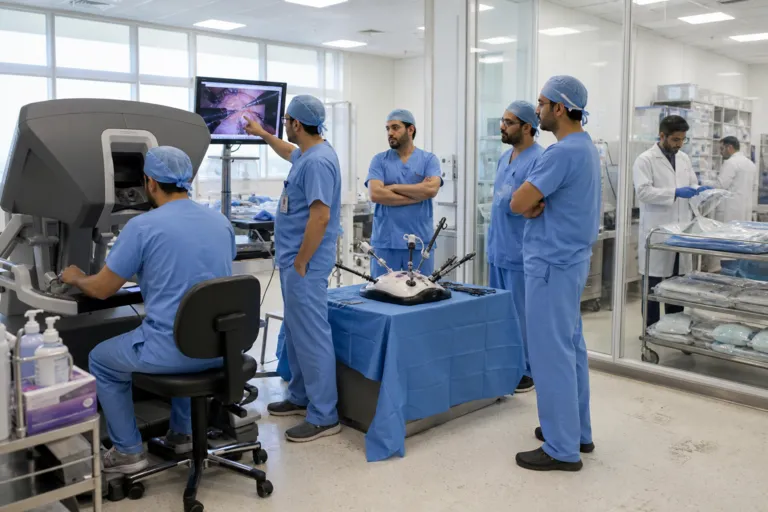
KFSHRC is using public forums to link advanced care with a broader innovation agenda, and that context matters for understanding why saudi robotic surgery is starting to look like it has crossed a clinical threshold. At the Global Health Exhibition 2025 in Riyadh, the hospital showcased a new manufacturing complex alongside advances in robotic surgery, genetic diagnostics, and augmented-reality medical training. The message is that robotics is not a standalone purchase. It is being framed as part of a system that connects care delivery, workforce readiness, and the ability to create new capabilities locally.
Even when the announcement focused on gene and cell therapy manufacturing, it included clear signals about clinical maturity and scale. KFSHRC said more than 200 patients have received CAR T-cell therapy there since 2020, before local manufacturing began. In the same communication, KFSHRC emphasized its international standing, including being ranked first in the Middle East and North Africa and fifteenth globally among the world’s top 250 academic medical centers for 2025. That blend of clinical track record and institutional ranking supports the idea that the hospital is positioning itself as an anchor site for advanced programs, including robotic surgery.
Beyond KFSHRC: Adoption Barriers Start to Look Solvable
The “beyond” part of the story is that the robotics sector is explicitly targeting long-standing barriers that can slow real-world adoption. MedTech Dive described a new wave of surgical robotics companies trying to improve outcomes and make less invasive procedures more accessible and affordable. The same report highlighted infrastructure limitations and surgeon shortages in certain specialties as barriers that multiple platforms aim to address. This matters for saudi robotic surgery because the path from pilot to routine use often depends on whether hospitals can fit systems into existing operating rooms and whether training can scale alongside demand.
Newer robotic designs and clinical studies are also being presented in ways that directly speak to operational realities. Johnson & Johnson’s Ottava system incorporates four robotic arms into a standard size surgical table, aiming to reduce the need for separate booms or carts. In a gastric bypass study, the robot was installed in six hospitals with operating rooms ranging in size from 243 to 694 square feet, and some rooms had not been used for robotic surgery before due to space constraints. J&J said the system can allow more hospital operating rooms to accommodate robotics, describing this as removing practical barriers to broader adoption.
Clinical signals from other robotic programs also show how vendors are trying to prove reliability and safety at procedure level. In Medtronic’s Enable Hernia Repair study, the company reported outcomes in 193 participants split between inguinal and ventral procedures. Among inguinal hernia repairs, zero patients reported major complications or surgical site infections during the procedure or in the 30 days that followed. In the ventral cohort, 2.1% of patients recorded an event, with both arms reported as well below the study’s cutoff of 30%. These kinds of results help shape surgeon confidence and hospital decision-making.
Saudi adoption is also happening in a wider digital transformation climate that can reinforce robotics programs over time. RapidAI partnered with Saudi Health Holdings Company to deploy deep clinical AI across 20 health clusters spanning all regions of the Kingdom of Saudi Arabia. The partnership is positioned as a pillar of a digital transformation strategy supported by the Health Sector Transformation Program under Vision 2030. While this is not a robotic-surgery deployment claim, it shows a parallel push toward scalable, enterprise technology foundations. In that environment, KFSHRC’s emphasis on training, diagnostics, and innovation-driven care provides a narrative bridge from flagship capability to broader clinical normalization.
What is KFSHRC highlighting that relates to saudi robotic surgery?
What clinical-scale signal did KFSHRC report that shows advanced care experience?
What does the Ottava study suggest about removing operating-room barriers?
What were key reported outcomes in Medtronic’s hernia repair study?
How does Saudi’s broader digital push connect to robotic surgery adoption?