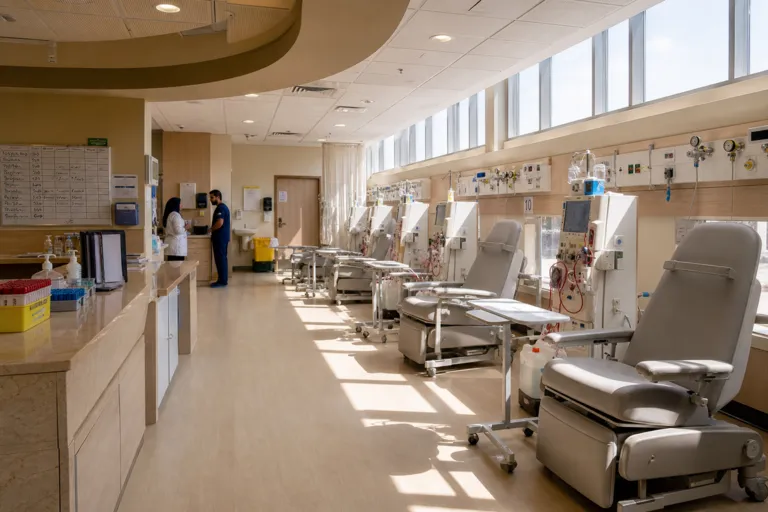
Saudi Arabia’s renal care outlook is being shaped by a steady push to expand dialysis access, modernize equipment, and improve patient monitoring. One market estimate values Saudi Arabia’s dialysis market at USD 0.14 billion in 2023 and expects it to reach USD 0.19 billion by 2030, reflecting a CAGR of 4.4% from 2024 to 2030. Dialysis is described as a life-sustaining procedure for end-stage renal disease (ESRD) and acute kidney injuries, spanning hemodialysis, peritoneal dialysis equipment, consumables, and related pharmaceuticals. Across the Kingdom, rising chronic kidney disease (CKD) risk factors such as diabetes and hypertension, delayed diagnosis, and non-communicable disease burden are cited as reasons more patients will require renal replacement therapies.
Network expansion and service scaling sit at the center of the Saudi dialysis market story. Ken Research values the Saudi Arabia Dialysis Services Market at USD 1.2 billion based on a five-year historical analysis, and highlights Riyadh, Jeddah, and Dammam as leading cities due to advanced healthcare facilities and higher population density. The same source states there are approximately 1,200 new CKD cases diagnosed daily in Saudi Arabia. In a separate Ken Research view of SNF-based dialysis, the prevalence of CKD is described as “alarming,” with approximately 1.2 million people affected. Mobility Foresights also frames infrastructure buildout as a key mechanism, noting expansion of dialysis infrastructure particularly in semi-urban regions to improve treatment penetration and reduce patient travel time.
From Machines to Models: Technology, Home Care, and Connectivity
Technology and care-model redesign are repeatedly linked to scale and patient experience. NextMSC describes modern dialysis machines as incorporating improved filtration mechanisms, enhanced portability, and user-friendly interfaces, while also pointing to smart technologies and connectivity features that support remote monitoring and data management. Renub Research commentary, as reported by Vocal Media, similarly points to home dialysis, AI-enabled monitoring, and advanced consumables as expected themes, and says Saudi Arabia has “significantly expanded its dialysis network over the past decade,” including specialty renal centers with advanced filtration systems, automated peritoneal dialysis (PD) devices, and digital patient monitoring tools. Mobility Foresights projects continued movement toward integrated care models that combine clinic-based expansion with growing adoption of home dialysis modalities, supported by remote patient monitoring and workflow automation.
Forecasts vary by source and market definition, but they consistently describe sustained growth. Mobility Foresights projects the Saudi Arabia Renal Dialysis Equipment & Services Market will grow from USD 118.6 billion in 2025 to USD 189.7 billion by 2032, at a CAGR of 6.9%, and attributes momentum to rising ESRD prevalence, higher diagnosis rates, and longer survival due to improved clinical protocols. Fortune Business Insights adds a global context point, stating that by 2026 Saudi Arabia is expected to generate approximately USD 0.82 billion in the market and account for nearly 0.8% of global revenues. On the provider side, Fortune Business Insights notes the competitive landscape is “semi-consolidated,” naming Fresenius Medical Care, DaVita Inc., and Baxter as key players capturing a significant share in 2025.
Dialysis growth also depends on recurring supply chains and reliable operations, not only new buildings. Mobility Foresights states consumables-driven recurring revenue is the largest contributor to market value, supported by high treatment frequency per patient, while also emphasizing that dialysis services require consistent quality control, clinical staffing, infection prevention, and reliable supply of disposables. Looking forward, it anticipates higher demand for high-flux dialyzers, biocompatible membranes, and improved water purification as quality standards tighten. In parallel, the sector narrative includes access and convenience, with providers expanding footprints in secondary cities, optimizing scheduling, and increasing chair utilization. This combination of infrastructure, connected technologies, and operational discipline frames how Saudi Arabia’s renal care capacity can continue expanding through the next set of forecasts.
What is the market outlook for dialysis in Saudi Arabia?
What is driving growth in Saudi Arabia’s dialysis demand?
How big is Saudi Arabia’s dialysis services segment today, based on the sources?
How is technology changing renal care delivery in the Kingdom?
What should readers know about the Saudi dialysis market forecasts across sources?